Deepl Translation
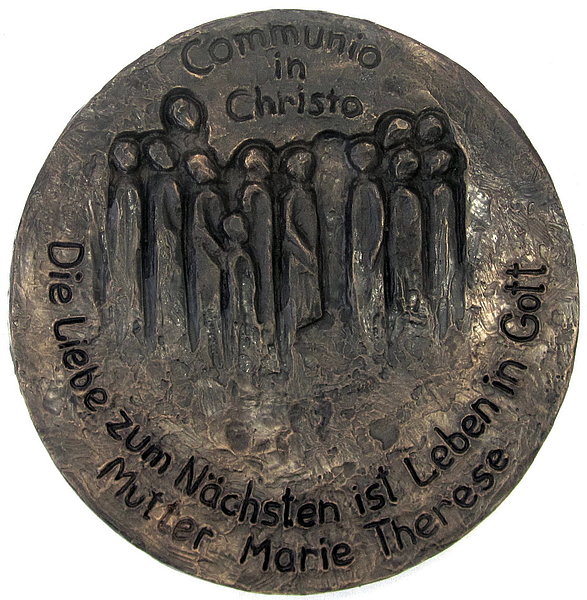
Mechernich/Blankenheim – Sometimes, significant deeds need not be grand in scale. The palm of a hand is almost enough to hold the bronze plaque that will, in future, be awarded once a year by Communio in Christo in Mechernich. Yet what it represents cannot be weighed or measured: as in the entire history of Communio’s founding, it is about active charity, loyalty to the community, service to others – and a quiet willingness to step in where help is needed, even when it does not make the headlines.
From 2026 onwards, the Ordo Communionis in Christo therefore intends to honour, on an annual basis, a person who has rendered outstanding service to the Communio, its social work or works of active charity. The new prize is to be awarded for the first time on 8 December 2026, the anniversary of the founding of the community established in 1984 by Mother Marie Therese, which was recognised under canon law as a *Consociatio privata*. The Chapter of the Communio in Christo will decide on the award.
The first recipient has already been chosen. However, their name will not be revealed for the time being. Communio in Christo wishes to announce it only at the formal award ceremony in December. Thus, the identity of the first recipient will remain a secret until then – though not the purpose of the award.
For the new prize is more than just an honour for past achievements. “It touches on a core aspect of Communio in Christo’s self-understanding: being a Christian not primarily as a confession on one’s lips, but as an attitude towards others,” says Father Jaison Thazhathil, the Superior General of Communio, who hails from India.
The founder, Mother Marie Therese, placed love for one’s neighbour at the heart of her spiritual path: “Communio in Christo – communion in Christ – therefore does not mean a community that is self-sufficient. It is meant to open itself up to the outside world: to the sick, the elderly, the lonely and those in need of help, to everyone whose dignity depends on another person recognising and protecting it.”
The award is intended to highlight people who do precisely this – something that is also practised in the facilities run by the Communio in Christo social welfare organisation: the wards for those requiring the most intensive care in Mechernich, the ‘Haus Effata’ care home for the elderly in Blankenheim, and the ‘Stella Maris’ hospice in Mechernich.
Symbol of community in bronze
The artistic design of the award to be presented is noteworthy: a rather modest yet substantial bronze plaque based on a design by the Bavarian sculptor Hans Wurmer. It depicts a group of people standing together, surmounted by the inscription ‘Communio in Christo’ and Mother Marie Thérèse’s motto: ‘Love for one’s neighbour is life in God’.
The figures below are not portraits. Wurmer has given them hardly any individual features. They stand close together, upright, reduced to the essentials. Large and small figures form a community. No one stands alone. No figure dominates the others. Only together do they form a single image.
Reverend Jaison: “It is precisely here that the theological power of this small work of art lies.” For “Communio” does not mean uniformity. Community does not arise from differences disappearing. It arises when diverse individuals give one another space and yet belong together. Wurmers’ figures remain individuals – and at the same time become part of a whole.
In its own way, the bronze thus conveys something of that concept which also underlies the New Testament image of the one body and its many members: every person has their own form, their own purpose and their own dignity. Yet no one lives solely for themselves. Thus, Hans Wurmer’s plaque takes on additional significance through its new purpose.
An artist from the early days of Communio
The fact that a work by Hans Wurmer, of all people, has become the symbol of the new award also forges a link to the early days of Communio in Christo. Wurmer was already working for the community during the lifetimes of the first Superior General, Karl-Heinz Haus, and the Spiritual Director, Hermann Walch. The Bavarian sculptor left behind works in several locations which remain part of Communio’s artistic and spiritual environment to this day.
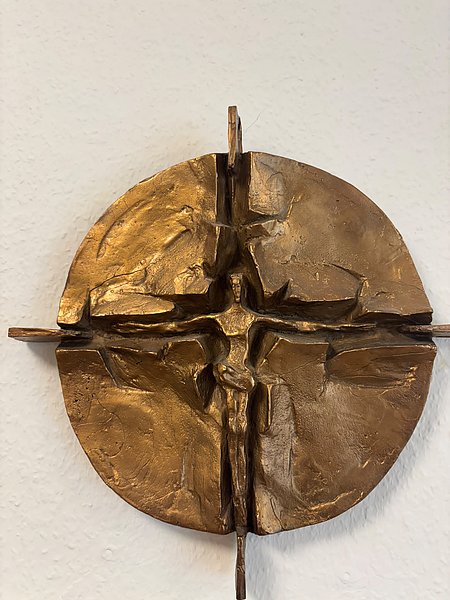
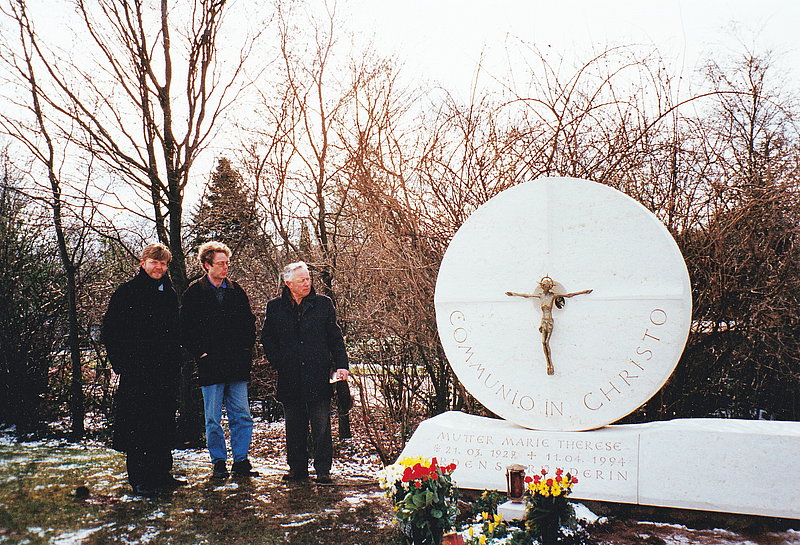
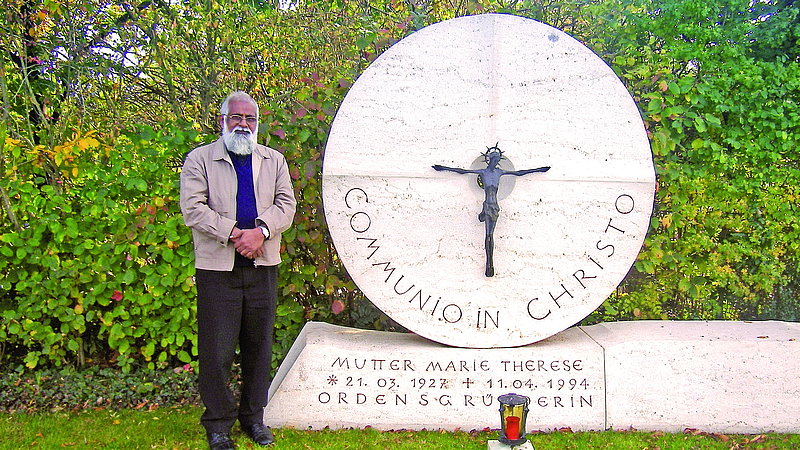
His works also include the tomb of the order’s founder, Mother Marie Therese, in the Mechernich cemetery. Wurmer also created a bronze relief for the chapel at ‘Haus Effata’, the care home run by the Social Welfare Organisation of Communio in Christo in Blankenheim. It depicts Christ not in a naturalistic style, but in a concentrated, almost eschatological visual language. The body of the Crucified One emerges from the undulating bronze, whilst horizontal and vertical lines intertwine the cross and the world, as it were. ‘For Wurmer, material, surface and figure become the vehicles of a spiritual message,’ says Norbert Arnold, managing director of the Communio Social Welfare Organisation.
This is also reflected, albeit in a different form, in the small Communio badge. Its surface is not smoothly polished. One can see the traces of modelling: indentations, raised areas and irregularities. The light catches in them and alters the faces and bodies depending on the angle from which they are viewed.
‘It is not sterile perfection that Wurmer seeks,’ says Arnold, who himself trained in a creative metalworking trade before studying law: “Wurmer’s bronze is allowed to bear traces. It’s just like in real life… Perhaps that is particularly fitting for an award for charity.” Those who turn towards another person engage with that person’s reality – not with an idealised image.
Not the deed alone
Communio in Christo attaches to this annual award a standard that is likely to go beyond that of traditional honours. The award is intended for people who have rendered outstanding service “to Communio, its social work and/or works of active charity”. This may take place in public – but need not.
“Church social work, in particular, relies to a large extent on people whose names rarely appear on plaques,” says Superior General Jaison Thazhathil: “Full-time and voluntary staff, carers and support workers, doctors, supporters, people who organise, listen, provide support, visit or simply stay when it would be easier to leave.” The Christian tradition, he adds, has a simple yet demanding standard for this: it is not the magnitude of a deed that determines its value, but the love from which it springs.
pp/ProfiPress Agency