Deepl Translation
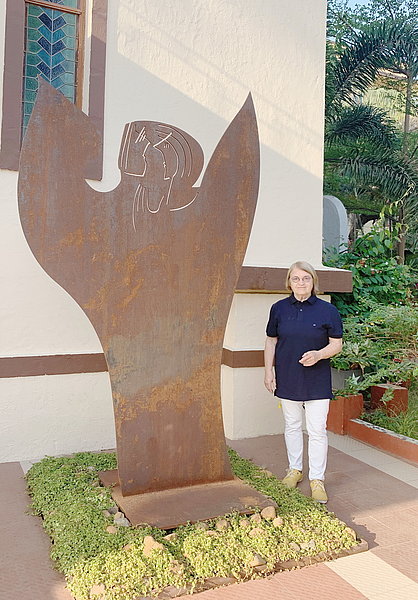
Zülpich/Mechernich/Mumbai – Sometimes, at the zenith of an artist’s long career, there stands an angel. One made of Corten steel, 2.90 meters tall, with two faces, two lines of sight, and a hollowed-out shape at its center that resembles a chalice. “Celestial” is the name of the artwork that Zülpich-based artist Marti Faber (80) donated to the Franciscan Missionaries in Mumbai.
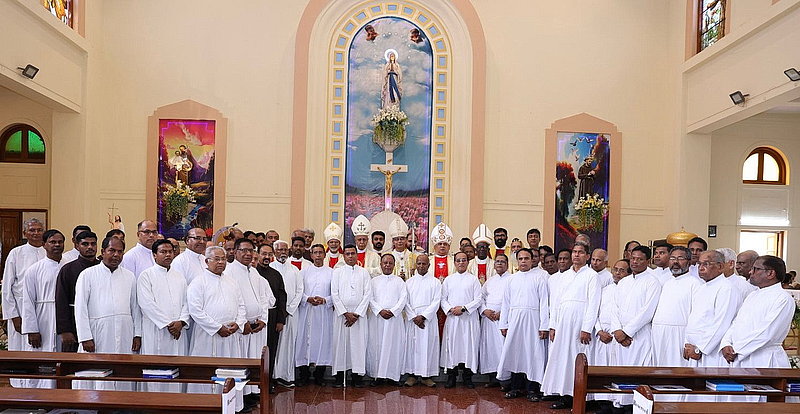
The angel now stands on its pedestal in front of St. Francis Church on Mount Poinsur in Borivali West, a district of the Indian megacity of Mumbai. There, it commemorates the 125th anniversary of the Congregation of the Missionary Brothers of St. Francis of Assisi (CMSF), which was founded in 1901 by Brother Paulus Moritz from Germany. The plaque on the pedestal lists the anniversary years 1901–2026, the location Mount Poinsur, and the German artist and donor: “Gifted by artist Ms. Marti Faber from Germany.”
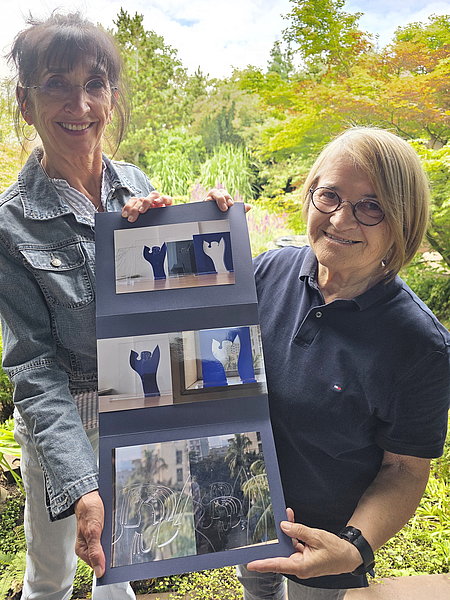
What was still just a design, a model, and a hope in the summer of 2025—when the Mechernich-based news agency ProfiPress first reported on it—has since become a reality. Marti Faber traveled to India with her plans in October 2025, originally intending to have a steel sculpture more than three meters tall fabricated on site using modern cutting technology. But Mumbai is not the Cologne/Bonn metropolitan area, and the metal workshops in the city’s neighborhoods operate differently from European shops with their computer-controlled lasers.
“They can repair and assemble all sorts of things there,” reports Marti Faber, “Improvisation is half the business. But it wasn’t possible to do it the way I had envisioned for my angel.” So the original idea evolved into an Indian solution: The angel became smaller, but not small. Instead of well over three meters, it now measures 2.90 meters. It was handcrafted in two parts, erected, welded, and anchored to a foundation dug specifically for it.
On the third Sunday of Advent in 2025, the time had come. Men in festive Sunday best stood around the massive structure, holding, aligning, welding, and working on the foundation as if they had internalized the fact that this was no ordinary metal object being installed. “They felt honored,” reports Marti Faber. “You could see how happy they were.”
A Work of Rust and Light
Corten steel changes on the surface. It rusts, forms a protective patina, and yet remains durable. This is exactly what suits this angel, which speaks of transience and, at the same time, of permanence. The surface comes alive with sun, rain, shadow, and time. Marti Faber also ensured that the artwork is illuminated. In the dark, the angel now casts a shadow on the church wall. She also designed the planting around the base herself. Anyone who knows Marti Faber knows this is no minor detail.
Her husband, Hein, was an experimental gardener at Bayer Leverkusen and later maintained the grounds at the Marienborn Monastery, where he also worked therapeutically with patients in the garden. Marti Faber herself has a keen eye and a green thumb for plants, spaces, and vibrant transitions.
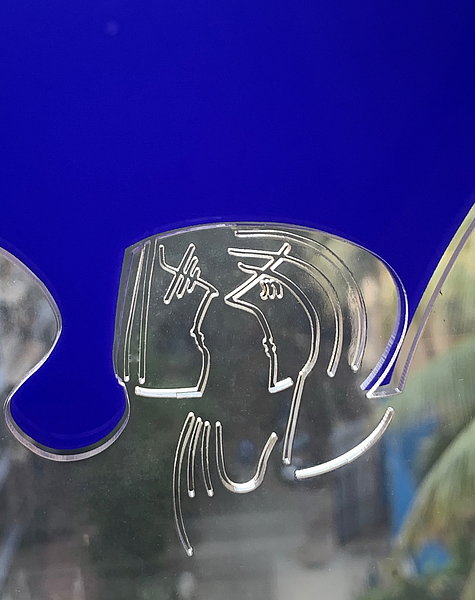
In front of St. Francis Church, steel, light, and greenery now stand side by side. The angel is a monument, a symbol of faith, and a bridge—all in one dual-faced figure. On one side, it commemorates the order’s founder, Paulus Moritz; on the other, it opens our view to his successors among the Franciscans—but also to you and me and every other person. Brother Joseph Karimalayil CMSF, the Superior General of the Franciscan Missionaries, had already emphasized before the installation that this angel connects the past and the future.
For Marti Faber, of course, there is something even deeper at stake. Between the angel’s two faces, a form emerges that she herself perceives as a chalice. This chalice connects the work in Mumbai with another work from her earlier creative period: Decades ago, she drew and painted a chalice for Communio in Christo in Mechernich, inspired by the founder, Mother Marie Therese, and the notes of the first Superior General, Karl-Heinz Haus.
Chalice Between God and Humanity
For Marti Faber, the Eucharist—Communion—means not only sacramental communion but also communication: It is the connection between God and humanity, the mystery of which Jesus spoke when he said that he is in the Father, just as the Father is in him, and that whoever remains in him also remains in God. From this perspective arises Marti Faber’s central theme: human dignity.
For Marti Faber, the connection to India did not come out of nowhere. It has its roots in the Eifel region, in Mechernich, at the Marienborn Monastery in Hoven, at Lebenshilfe, and at Communio in Christo—full name Ordo Communionis in Christo—in Mechernich. She was already active as an artist there more than 25 years ago. There she also found an inner spiritual bond with people who were cared for, accompanied, supported, and sometimes attended to until their death.
In the care facilities of Communio in Christo and at the Stella Maris hospice, she drew portraits of guests and residents. She also encountered people with disabilities, the sick, the suffering, and the dying in Lebenshilfe facilities—especially in Bürvenich—and in Marienborn. Not as an outside observer, but as someone who sits down with them and truly sees them.
Marti Faber does not interrogate people. She does not pressure them. She says of her work: “I don’t get in anyone’s way. There’s nothing between us.” For many of the people she encountered, every day looked the same from the outside. The same rooms, the same routines, the same care, the same apparent immutability. Marti Faber, however, sees the differences and subtle changes—a glance, a tension in the face, a hint of alertness—people who are not reduced to their suffering.
She recounts the story of a dying man who at first seemed completely apathetic and aloof, but as she sat with him for weeks and drew him, something changed. In the drawings, it almost seems as if they were created in reverse order: not as a journey toward death, but as a progression toward greater presence. “He came back to life,” she says, in essence; simply because someone was there with him and turned toward him, other residents—who had literally left him for dead—began to care for the man as well.
For Marti Faber, this encounter was much more than an artistic or therapeutic experience: “It was my encounter with Jesus.” She later learned from the brothers at Mother Teresa’s house in Mumbai that the man had died on the very day she was back on the plane heading back to Germany.
“I Depict People”
To understand Marti Faber, one must look to her childhood. As the daughter of Hungarian parents, she came to the West after the failed revolution of 1956. Her family had lost everything for the second time: first through World War II, then through their flight from the Eastern Bloc. At age ten, she still didn’t speak German.
Drawing became a form of balance for her, but much more than that: a language. Part of her means of communication, as one might soberly put it. She herself puts it more beautifully: “I depict people.” Even as a child, she was very curious. This curiosity turned into openness. Out of her inability to speak grew a different way of engaging with the world. Marti Faber learned to see. Later, she studied art, including at the academy in Málaga. She cites Rembrandt and Michelangelo as her great role models when it comes to seeing, as well as Pablo Picasso.
At the academy, she observed how everyone drew the same model, yet each person captured something different on paper. “I learned to see,” she says. She particularly enjoys drawing elderly people: “Their whole life is captured there.”
Journalist Bruni Mahlberg-Gräper, who has followed Marti Faber’s work for many years and often written about it, says her drawings are “very natural and yet abstract.” That hits the nail on the head. Faber’s drawings are not photographic reproductions. They take people seriously without defining them. They show pain, but they do not expose anyone. They are not an outgrowth of voyeurism; on the contrary, they seek dignity in the human face.
Over the decades, this approach led Marti Faber to Mother Teresa’s homes in India. There she drew suffering and dying people, just as she had begun doing in the Eifel region. The external circumstances are not easy. There are odors, cramped quarters, poverty, and illness. People there are not in clinically isolated settings. Brothers and sisters care for them with devotion.
Marti Faber felt free there. The religious were delighted that she came, sat with them, observed, drew, and pitched in. There, too, her focus was not on misery, but on presence. On dignity. On the individual human being.
On April 15 of this year, Marti Faber celebrated her 80th birthday in Mumbai. “Celebrated” may not be the right word—at least not in the usual sense. She spent the day at one of Mother Teresa’s homes, among the sick, the dying, and the people who care for them. In honor of her birthday, she paid for a meal for about 200 sick people and members of the order.
She got the idea from a man who comes to this house every year on his birthday to serve the meal there. He had given her his business card, complete with his doctorate and all the trappings that go with it. Marti Faber adopted the gesture in her own way. A birthday as a gift—not as a reception.
The Angel and the Children
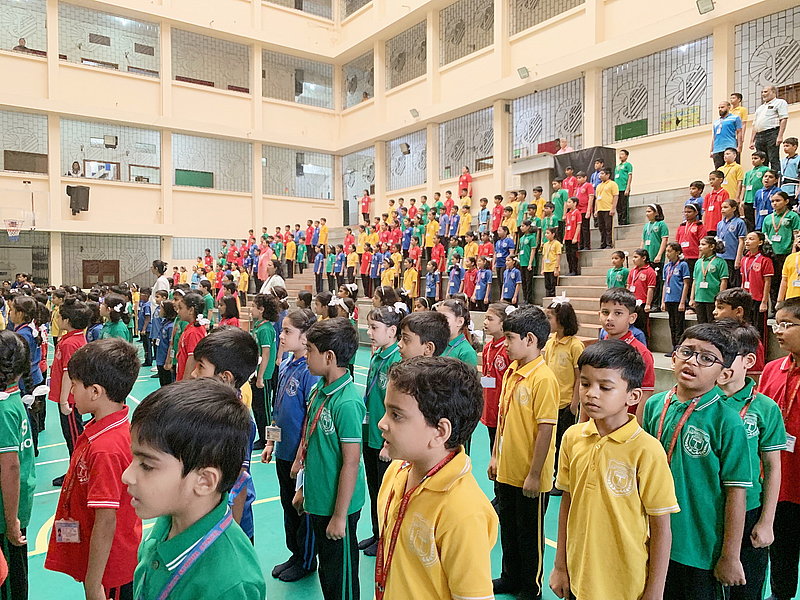
But the trip to Mumbai was not just a journey of art and faith. Marti Faber took her granddaughters, Anja and Julia, with her. Anja was twelve and turned 13 during their stay in Mumbai; Julia was 14. For five weeks, the two attended a Franciscan school.
In a sense, this was a small trial run for what is now being planned on a larger scale: a student exchange between India and Germany. Marti Faber had long piqued her family’s curiosity with stories from India. Her three children—two daughters and a son—as well as her five grandchildren were familiar with her tales. When she asked Brother Joseph if the girls could come, he agreed.
Classes at St. Francis School are taught in English. Anja and Julia were able to follow along. At the same time, the Franciscan Missionaries place great importance on teaching German as the first foreign language at their schools. This has already built a bridge between the two cultures.
The girls enjoyed their stay so much that they would have liked to stay longer. That wasn’t possible. But this experience gave rise to a new idea: Why not develop an official exchange program? Together with Brother Wilfred Monteiro, the principal of St. Francis School on Mount Poinsur in Mumbai/Borivali, Marti Faber further developed the idea. The program is titled “Becoming Global Citizens Through Education.” Brother Wilfred visited Zülpich in the spring and presented the project at several schools together with Marti Faber.
Marti Faber has since written to a total of eleven schools, including the Gymnasium am Turmhof in Mechernich, the Frankengymnasium in Zülpich, the Hermann-Josef-Kolleg in Steinfeld, and the St.-Angela-Gymnasium in Bad Münstereifel. Brother Wilfred visited some of them in person. There are also connections to Stuttgart, Mumbai’s sister city. A partnership already exists between the St. Francis School and a high school in Stuttgart.
In the Rhineland, Roswitha Schütt-Gerhards, the former principal of the episcopal Clara-Fey Schools in Schleiden, showed particular interest. Even after her retirement, she intends to continue supporting the project. The plan is for 10 to 15 children from Germany to travel to India next January, live with host families there, and experience everyday school life. In May, children from these Indian families are scheduled to come to Germany for a return visit. The exchange is not intended to be a tourist sightseeing trip. It is about encounters, everyday life, school, language, family life, and cultural understanding.
St. Francis School puts it this way in its mission statement: Education should not be limited to the four walls of a classroom. True education helps students develop intellectually, emotionally, socially, and culturally. Or to put it more simply: Young people should learn to view the world not only from their own perspective.
Art Class in Mumbai
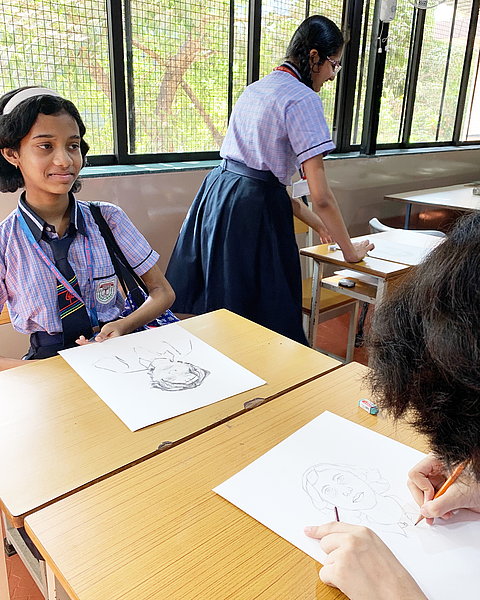
Marti Faber herself also got involved at the school during her stay. She taught art. First, she had the students draw birds. Then they redesigned the classroom together. Finally, they were asked to draw one another. As homework, the children were given the assignment to draw each other at home with their parents and siblings.
“Art allows you to connect with people,” says Marti Faber. That’s more than just a nice saying. It’s the essence of her life’s work. In Mechernich, in Bürvenich, in Marienborn, at Communio in Christo, in the Houses of Mother Teresa, in the classroom at St. Francis School, and in front of St. Francis Church on Mount Poinsur, the focus is always the same: to truly see a person before speaking about them.
Marti Faber donated some of her works from India to the school, others to the convent. Her works were also hung in one of Mother Teresa’s houses. “I’m leaving my mark,” she says. These traces go far back. Marti Faber never completely severed her ties with Communio in Christo in Mechernich. Just at the beginning of this year, she attended the funeral of Sister Dorothea, a member of the community over 90 years old who had played an important role in the founding history of Communio in Christo.
So the spiritual lineage remains intact: Mother Marie Therese, Stella Maris, Communio, communication, the chalice, humanity, dignity. And now Mumbai, the Franciscan Missionaries, Mother Teresa, St. Francis School, and young people who are meant to get to know one another across continents. Seen in this light, the angel “Celestial” is not merely an anniversary monument. It is a symbol of what Marti Faber has been doing for decades. She sees and portrays people, and through her, God bestows His attention upon them.
The angel on Mount Poinsur looks back on 125 years of Franciscan ministry. But he also looks ahead: to children who are to become global citizens without losing sight of the dignity of each individual. Perhaps that is precisely the message of Marti Faber’s angel with two faces: Whoever truly looks at a person never sees just a person, but feels a sense of connection.
pp/Agentur ProfiPress